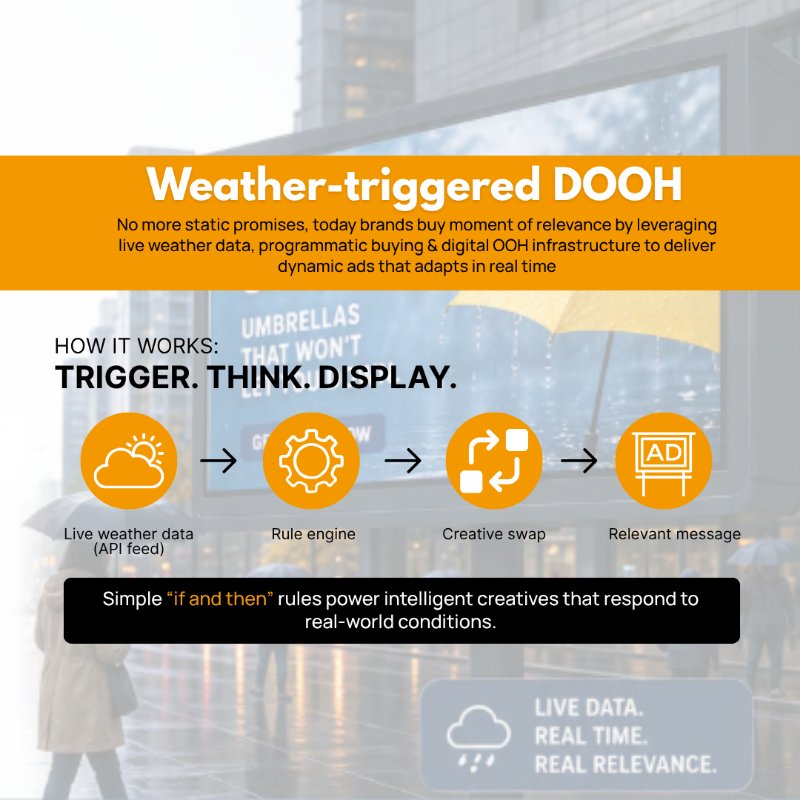
Weather-triggered DOOH: Real time context meets the real world
For decades, traditional OOH operated on fixed schedules and static promises. A brand paid for a billboard, uploaded a poster, and hoped the message landed, regardless of whether it was blazingly hot, pouring rain, or freezing cold.
Today, the convergence of programmatic buying, live data feeds, and digital OOH infrastructure has rewritten that equation. Advertisers no longer buy static physical space; they buy moments of relevance. At the centre of this shift is weather-triggered digital OOH, where dynamic creative optimisation meets real-time meteorological data to turn everyday outdoor screens into contextual engines.
Weather shapes human behaviour, impulse decisions, and buying intent. A muggy afternoon sparks a craving for an iced beverage, while a sudden downpour sends commuters hunting for umbrellas, ride-shares, or warm shelter.
Weather-triggered advertising leverages these physical realities using live condition data. Instead of serving a generic message, screens automatically evaluate data feeds, such as temperature thresholds, precipitation, UV index, or air quality, and instantly display the matching creative. For instance, an API feed tracks local conditions in real time, sends that information to a rule engine, and when specific criteria are met, the screen immediately swaps to the relevant ad.
Real-World Execution and Trigger Logic
The engine behind weather-triggered campaigns relies on simple "if and then" rules tied to programmatic ad stacks.
Temperature-Driven Demand: Fast-food chains and beverage brands run campaigns where screens activate only when ambient temperatures cross a specific threshold, such as thirty-two degrees Celsius. The screens instantly display frosty drinks and ice cream, driving significant lifts in store foot traffic.
Precipitation and Shelter Drops: Retailers and food delivery platforms configure rules stating that if precipitation exceeds zero millimetres, the creative swaps to rainwear, umbrellas, or hot food delivery. The moment the rain stops, the display reverts to its standard brand campaign, eliminating wasted impressions.
Environmental and Seasonal Context: Health brands connect billboard inventory to live Air Quality Index feeds. When pollution spikes above healthy thresholds, billboards near transit hubs automatically display air purifiers or protective face masks.
Key Advantages over Static Outdoor Media
1. Zero Wasted Ad Spend
With programmatic digital out-of-home advertising, media buyers pay exclusively for plays that fire when trigger conditions are met. If a rain-triggered campaign experiences a week of clear skies, the creative never runs, and the budget remains untouched on standby.
2. Contextual Resonance
When messaging aligns with a consumer's immediate physical environment, cognitive friction drops. A billboard offering a hot beverage on a cold, grey morning feels like a timely solution rather than an intrusive ad.
3. Seamless Multi-Channel Handoffs
Weather-triggered screens work best as an entry point in a broader digital ecosystem. Geofenced screens trigger contextually relevant creative that prompts users to open mobile apps, redeem localised promo codes, or follow directional foot-traffic maps.
4. The Road Ahead
As smart cities expand and digital billboard inventory becomes more interconnected, weather triggers are shifting from novel marketing tactics to standard campaign architecture. By marrying real-time digital intelligence with high-impact physical displays, brands can ensure their message is always right for the moment, whatever the weather brings.


